
Dr. J walks through five thyroid lab patterns that often get labeled “normal” even when someone still has thyroid symptoms like hair loss, cold hands and feet, eyebrow thinning, constipation, brain fog and low mood. He explains why TSH is a late-stage marker, how functional ranges for TSH, free T4, free T3, total T4 and total T3 differ from conventional ranges, and why lab ranges can even vary by region. He covers high normal TSH, low free T4 with a normal TSH, rising TPO and thyroglobulin antibodies, low normal free T3 and poor conversion, and mixed patterns. He also explains how cortisol, blood sugar, insulin resistance, gut health, gluten, and nutrients like selenium, zinc, iron, vitamin A and iodine can play a role, why iodine needs care when antibodies are present, and how at-home basal body temperature testing can add to the picture.
What You’ll Learn
Why TSH is a late-stage marker and can miss early thyroid dysfunction
The functional ranges Dr. J uses for TSH, free T4, free T3, total T4 and total T3
Five thyroid patterns that often get missed on a standard lab panel
How TPO and thyroglobulin antibodies can change your thyroid numbers
How cortisol, blood sugar, gut health and nutrients affect thyroid function
How to use basal body temperature as an at-home thyroid clue
Key Highlights
Related Health Resources
http://www.justinhealth.com/gluten-video-series
http://www.justinhealth.com/thyroid-hormone-balance
http://www.justinhealth.com/female-hormone-balance
Subscribe for weekly functional medicine content:
http://www.justinhealth.com/subscribe
Dr. Justin’s Links:
http://www.justinhealth.com/links
Reference
Association of Thyroid Function with Insulin Resistance: Data from Two Population-Based Studies. Eur Thyroid J. 2022;11(2):e210063.
https://pubmed.ncbi.nlm.nih.gov/35085102/
Podcast Transcript
[00:00:00]
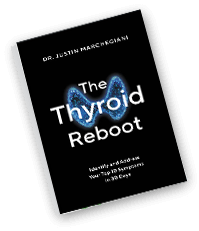
Dr. Justin Marchegiani: Hey, guys. Dr. Justin Marchegiani here. Today we’re gonna be talking about five thyroid patterns that you may have. You may still have thyroid symptoms, but your conventional MD or endocrinologist says you are normal. We’re gonna go over those lab panels here in just a minute. And again, we talk about some of these things in the Thyroid Reboot book, thyroidreboot.com.
That’ll bring you to the link on Amazon, and you can take a look there. I’d love for you guys to give me a review. We talk about a lot of different thyroid patterns, and I’ll give you the ins and outs on what that means. Now, from a conventional [00:01:00] medical standpoint, this is not medical advice. We’re talking about functional patterns, functional dysfunction.
We’re not talking about disease and pathology. Typically, your conventional endo or your PCP is looking at elevated TSH, and usually with that elevated TSH, you may have some low thyroid symptoms along with it. You may have swelling of the thyroid. That may be an early progression of a goiter.
You may have hair loss, cold hands, cold feet, eyebrow thinning, constipation, mood issues, anxiety, depression. These are all potential patterns for thyroid dysfunction. Now, most times they don’t really look downstream at T4 or even T3 or any of the autoimmune markers that may go along with it. So for instance, with T4, maybe they run a total T4 and see it below 6.
6 to 10 is our functional range. Maybe it’s in the 5s or 4s. Maybe they run a free T4 and it’s 1 or below 1. These are signs that it could start to become a problem on the T4 side. So typically, you’re gonna get your TSH. The functional range that we look at [00:02:00] is 0.5 to 2.5.
Once you start going above 2.5 to 3, it starts to become a little bit of an issue. Most times you’re gonna get picked up on a lab anywhere between 4.5 and 5.5, because it’s all gonna be area specific. Usually on the West Coast, it’s four and a half. It’s a little bit lower on the TSH scale. You go more East Coast, you’re around five and a half.
I always told patients, “Hey, the easiest way to conventionally solve a thyroid issue is just take a trip from the East Coast to the West Coast, because the lab ranges differ.” Obviously, it’s a joke. You’re not fixing the problem. So some of these lab ranges will differ by area. Now that being said, we have a nice broad range for TSH.
Again, TSH is a late-stage marker. When TSH goes high, it’s usually been going on for a while. As TSH creeps up, it’s an inverse hormone. It’s like talking to your kids, right? Like, “Hey, Johnny, take out the trash.” Okay, great. He didn’t do it. Let’s do it again. “Hey, Johnny, take out the trash.” And then you just keep on escalating because Johnny’s attention and listening [00:03:00] is dropping, right?
So in our analogy here, TSH is the parent talking to the kid, and T4 is the child responding. As we have less response from the T4, the TSH goes up to try to bring it up. Now, we also have T4 converting downstream to T3, so it’s a little wrinkle in our analogy, but it still works. T4 gets converted to T3.
Usually the T4 to T3 conversion is pretty good in healthy patients. So if we’re in the middle of the reference range for T4, hopefully we’re in the middle of the reference range for T3. So if free T4 is 1 to 1.5, we wanna be somewhere between 3 and 4 with free T3.
So it just kind of gives you an idea. I’m gonna go over some of these patterns here, and we’ll talk about some of the things that I see clinically. We have a nice nuts and bolts section right in the early pages of the book. So this is interesting here. [00:04:00] Inflammation and its effects on TSH.
This is page 21 in my book, and it talks about inflammation and autoimmunity. The thyroid has to be inflamed and beaten up for quite a while for TSH to start to register a thyroid hormone problem. It’s usually a delayed marker. It takes a while. So we want other markers to pick up issues before we have to wait years and years for you to get picked up on the conventional side.
And the biggest problem with most conventional support for thyroid is it’s gonna be a synthetic T4 molecule: levothyroxine, Synthroid, Levoxyl. It’s gonna be tetraiodothyronine with a sodium molecule attached to it. It’s that way so they can patent it, right? They used to give glandulars for over 100 years with Armour or WP or NP.
Armour was around in 1910, 1920. They’ve been doing it for quite a while. And that has the T4 molecule, it has the T3 molecule, it’s gonna have protomorphogen proteins in there, PMGs. It’s gonna have calcitonin. It’s gonna have T2 in [00:05:00] there. It’s gonna have other compounds and other nutrients because it’s a glandular.
So I always like things that are more natural and that also have more nutrition for the thyroid as well. You won’t get that with your typical synthetic T4. Now, it will lower the TSH, because the biggest thing is we don’t want elevated TSH. Elevated TSH is going to overstimulate the thyroid, can create a goiter, and can cause thyroid tissue to proliferate, if you will: grow, enlarge and swell.
Not good. So let’s go over a couple of these markers and make sense of it all. So we have our conventional TSH. We have high normal TSH. Let’s say it’s in that 3 to 3.5 range. Remember, like I said, 4.5 to 5.5 is our typical conventional TSH cutoff. If you’re high like that, definitely go see your conventional doctor.
But a lot of times you’re just gonna get some levothyroxine to knock it down, which is good, but then you may still have symptoms. This is where people come and see me all the time, where they’re still gonna [00:06:00] have the hair loss, the thinning, the cold hands, the cold feet, the brain fog, the constipation.
So you really have to look deeper at the whole situation. And again, free and total T4 and free and total T3 may be normal, right? So your body may be wanting to bump up this T4 and bump up this T3, and it’s doing it by whipping a tired horse. That TSH is going higher for a reason. Now, there could be interplays here with cortisol.
We have to look at cortisol. There could be interplays if you’re a female with lower progesterone, if you’re perimenopausal or menopausal. There could be interplays with insulin resistance. So these are all other factors that can increase the TSH and cause it to be a little bit higher while you still have decent free T4 and decent free T3.
Now, our free T3 range is about 3 to 4.2. Our free T4 range is 1 to 1.5. Our total T4 is about 6 to 10, right? Conventionally it’s about 6 to 12. And then our total T3 is about 100 to [00:07:00] 140, 150-ish. So that’s kind of our first pattern, right? TSH is under the threshold for conventional medicine, so it’s not quite gonna be picked up.
You may still be having symptoms, and you wanna know next steps. Number two here: we have normal TSH, but we start to have low free T4, and maybe we start to have free T3 issues. So our TSH is now good. It’s in range. Let’s say it’s at 1 or 1.5. Our free T4 is starting to drop.
We’re starting to go outside of the functional range. Maybe we’re at around 0.8, 0.9. A lot of times with that conversion, as free T4 converts to free T3, maybe our free T3 is 2.8, 2.7, 2.6. And again, the free fraction of our thyroid hormone is about 2% to 5% of our hormone.
The other 95 to 98% is bound. I’ll typically run free most of the time, which is usually enough. If we’re looking at someone a little bit [00:08:00] deeper and we’re concerned, we may look at total as well. But almost always, total and free tend to follow the same pattern, if you will. So now TSH is good. Maybe it’s around 1.5.
Our free T4 may be 0.8. Maybe our free T3 is still at 3, or maybe it’s a little bit below that, 2.8, 2.7, 2.6, but it’s not super low. It’s not in that bottom 25%, if you will. It’s getting close, but it’s not quite there. Now again, why isn’t the TSH going up? We’re still gonna be looking at cortisol.
We’re still gonna be looking at stress and dysregulation of the HPA axis, the hypothalamic pituitary adrenal axis. That’s gonna be one of the first things we look at out of the gate. We’re gonna look at blood sugar. Blood sugar can be a big thing. Stress and inflammation all play a big role. Of course, certain nutrients are also important, right?
If we don’t have the building blocks, let’s say we’re low in iodine, low in selenium, low in copper, low in zinc, these can all be big players. Again, we have to be very [00:09:00] careful when dealing with iodine. We don’t need a lot of it, like 150 to 250 micrograms, but if we’re very low, it could be an issue.
But also, if we have autoimmunity, if we have antibodies, and I’ll go into this in other patterns down the road, taking iodine can increase the iodination process. If we do have an autoimmune mechanism in play where we have TPO antibodies or thyroglobulin antibodies elevated, that can sometimes provoke the immune response, and we can actually have more TPO or TG antibodies coming in and attacking that thyroid tissue.
It’s very, very possible. So it’s important that we have that assessed completely. That’s really important out of the gate, because we don’t want to give iodine and make someone’s autoimmune issue worse. But also, what if we’re eating gluten? What if we’re eating inflammatory foods? What if our gut’s all jacked up and we have a very permeable gut, leaky gut for short?
These are all important things. Now again, with our TSH in range, this is almost always gonna get missed by your conventional medical doctor because you’re missing the telltale signs. A [00:10:00] better conventional MD may run free T4, but most don’t. Usually they’re gonna screen you with a TSH, and they run a reflex test.
So the TSH has to be off, and then they run T4 with it. If your TSH is good, then you’re gonna get stuck, right? So this is a discordant pattern, and we need to look at other factors. Now again, the gut is such a big player with all this, because anywhere from half to 80% of thyroid issues, depending on what scientific article you look at, have an autoimmune mechanism at play. And we know 80% of our immune cells are in the gut.
So if we have an autoimmune issue that’s brewing in the background, and let’s say we have poor digestion, dyspepsia, we’re not breaking down our food well, we’re bloated, we’re gassy, maybe we have low stomach acid, that could really impact our ability to break down and absorb these functional cofactor nutrients.
The protein, the tyrosine, the selenium, right? The conversion enzyme that makes T4 into T3, [00:11:00] its important cofactors are selenium-based. Iron is so important, if any anemias are present. Copper and vitamin A matter too. Vitamin A is also a big one for TSH. So when we see big TSH problems, we always wanna make sure vitamin A is dialed in and supported as well.
That’s really important. All right, so the next one, number three: upper normal TSH, but now we start to have antibodies. Now we’re starting to see some TPO. Now we’re starting to see some thyroglobulin antibodies. Our TSH can start to flare up a little bit because now our immune system is coming in, right?
These little Y things, these are our antibodies, the TPO and the TG antibodies, and now they’re attacking the thyroid. Hormone levels can spill out a little bit, so you could even see T4 and T3 go a little bit high acutely, because the autoimmune attack is causing these hormones to spill out of the thyroid gland, and we’re having acute increases in our thyroid hormone.
It could also cause the TSH [00:12:00] to not go super high, to not be flagged, because we have enough hormone coming out that the feedback loop keeps that TSH down. So it’s possible that TSH may still be normal-ish, high normal, but not be flagged, and we could start to have anxiety, irritability, maybe sleeplessness.
These could all be big players in this. This is why we have to look at it and see what kind of pattern we have. Anytime we have an autoimmune wrinkle where these TPO and thyroglobulin antibodies are surging, it could easily cause surges in T4 and T3, and that could lower our TSH even if it was running higher, and it could impact our T4 and T3 levels.
We could have acute elevations, or we could even be a little bit low, depending on how chronic that autoimmune pathway has been. All right, number four: now we have normal TSH, normal T4, but we have this low normal free T3. The typical free T3 that’s flagged low on a lab range is around 2.2, but let’s say we’re at 2.9, 2.8, 2.7, 2.6, [00:13:00] right?
We’re starting to be in the bottom half of the reference range for free T3. Remember, the optimal is 3 to 4.2-ish, but now we’re starting to go into the mid to upper 2s. Maybe we’re starting to have some temperature issues. The big thing I’ll do is have you run a basal temperature test at home.
For a female, we’ll typically do it between days two and six of the cycle. For a man, any day. We’ll test either oral or axillary: 97.8 to 98.2 for axillary, 98.2 to 98.6 for oral. That’ll give us a pretty good window of where our temperature’s at, and if we’re below that, that can be a thyroid issue.
If it’s bouncing around more than 0.3 from day to day, that could also be an adrenal issue, because cortisol can easily impact that as well. So these are important factors we have to look at. Again, I look at the totality of the clinical picture. We have objective markers that are clinical, right?
These could be the temperature. These can be lab tests. [00:14:00] These can be symptomatic markers: how you feel, hair, energy, circulation, cold hands, cold feet, constipation. Obviously, gut issues, SIBO and parasites can all impact it as well. So we have to look at the big picture of everything, not just the small picture.
Again, in a short conventional medical visit, it’s hard for your conventional MD to take all this information in. One, they aren’t even trained in it, and two, if you don’t have that elevated TSH, they’re typically stuck because they’re practicing a standard of care model.
Nothing wrong with that, but if you don’t fit into it perfectly, you’re gonna get missed. And again, this isn’t a disease process. This is more of a dysfunction issue, right? So this is where functional medicine comes in. It’s good to get screened by your conventional MD for disease, but what if you don’t fall into that pattern?
Now what? All right, so we talked about the normal TSH and T4. Now we have this free T3 on the lower side. We [00:15:00] talked about conversion. There could be autoimmunity here. I mentioned autoimmunity more in number three, but there could still be a little bit here. It’s possible. There could still be nutrient issues.
There could still be a selenium or zinc issue. Glutathione is really important. The liver is really important because that’s where a lot of our deiodinase enzyme activity happens, and it’s very much selenium and glutathione dependent. Selenium is a very important glutathione recycling nutrient. It’s also a root cofactor for the enzyme that activates and converts thyroid hormone.
The gut could also play a role, because other nutrients are still involved: vitamin A, copper, zinc, magnesium. We could even throw CoQ10 in there. They’re all important nutrients, and any gut dysfunction can impact them. Now, of course, number five, we can have a mixed pattern, right? We can have a normal TSH, and free T4 starts to get low, but borderline.
Maybe it’s sitting around 0.9, right? It’s not gonna be flagged by your conventional MD. [00:16:00] T3 is borderline. Maybe we’re at 2.8, 2.7. Definitely not flagged. You’re starting to have some symptoms. Maybe you’re starting to get a little tired. Maybe your hands start to get a little cold, maybe a little bit of hair loss, maybe eyebrow thinning.
Maybe you’re starting to notice a little bit of constipation or brain fog. There could be some brewing antibodies. You could see your TPO around 40 or 50 on a blood test. For thyroglobulin antibodies, I think the conventional range is around 0.9, so 1 or higher gets flagged.
Maybe you’re sitting at 3 or 4. Just a low-level mixed pattern, right? A mixed antibody pattern. That could be a player in this. And of course, everything to do with the gut becomes vital. Gluten, dairy, any of the conventional foods that could provoke an autoimmune response could be a really big deal to look at.
We have to look at the entire pattern. And again, I go into the big patterns in my book, and I just talked about a handful of things here. The book is at thyroidreboot.com. Take a look at that. There’s a lot of things you can do. The conventional medical protocol is [00:17:00] gonna be: take this levothyroxine, anywhere between 25 and 100 micrograms.
Take it, get your TSH normal. Okay, great. What if your TSH is already normal? What if it’s borderline normal? What if you have these other patterns that are downstream? Conventional medicine doesn’t even really look at antibodies. Why? Because it’s an autoimmune condition, and it’s handled differently than conditions like MS or Parkinson’s.
Let’s go into Parkinson’s. Parkinson’s may have an autoimmune mechanism to it. That may be a little bit controversial, but there’s an autoimmune mechanism where the substantia nigra dopamine neurons are getting depleted and attacked. Or MS, or any of your IBD conditions, right? Think Crohn’s, think ulcerative colitis.
Usually, you’re seeing drugs that are either steroid-based, or you’re gonna see biologics that suppress the immune system, whether they’re suppressing TNF alpha or suppressing interleukin 12 or 23. There are different ones that will suppress these [00:18:00] parts of your immune system.
None of this addresses the underlying issue, and those medications all have side effects. And Hashimoto’s tends to be a little bit more subtle and not as overt symptomatically as other major conditions. They tend not to use any of these drugs on a thyroid autoimmune issue.
So you’re kind of stuck. They don’t even really look at it because it won’t change their treatment. But it does change things for us, because we look at gut issues, nutrient issues, and whether our blood sugar is getting wonky, right? Insulin resistance is a big deal. You can go on PubMed or ChatGPT and pull up studies on “low triiodothyronine,” that’s T3, “and diabetes,” or “and insulin resistance,” or “elevations in TSH and insulin resistance.”
You’ll see all kinds of studies on that, because there’s such a strong blood sugar and insulin correlation with optimal thyroid function. All right, guys. I hope you enjoyed today’s video. If you did, there’s a link down below in my bio to reach out to my staff and [00:19:00] me. We see patients worldwide.
I’m an expert in this topic, and I’ve got a book on it. Feel free to grab that if you want more insight. My staff, my team and I see patients worldwide. If you want more support or help, there’ll be a link down below to justinhealth.com. There’s a Work With Dr. J button there you can click, and then we can reach out and see if you’re a good fit for care.
All right, guys, any questions, let me know. I’d love to see your comments down below. I’ll be personally answering those. You guys have an awesome day. Take care, y’all. Bye now.
 speak pipe
 Rumble
 Youtube
 Apple
 LIBSYN
 Bitchute